

Tawny Yellow Nets
A beautifully recursive poem, the stuckness, and a wordless children's book

Another poem this week, and a book (or two) without words. Together, these create a moment of looking both forward and backward, in and out. What is your point of perspective at any given moment? How quickly do you lose yourself in the opening of the nesting dolls?
“Life can only be understood backwards; but it must be lived forwards." — Søren Kierkegaard
Hello!
After writing last week about memorizing the Edna St. Vincent Millay poem, I was thinking about what poem I might carry along next, what linguistic touchstone I might tuck in my pocket on a Monday and live with through the week. I hadn’t started looking. I was just thinking it’s a system of living with single poems and flossing my mental strands each week that I should put in place, a revolving door and a mindful routine.
Somehow, and this really is a mystery, I randomly opened a file, one of thousands, and a poem by Robert Graves stared back at me. I hadn’t even realized the file I clicked contained a poem.
I had unknowingly pulled a string
and triggered a tunneling of existence.
Markers of beginning, end, and truth
dissolved, erased with a swipe
of spit-wet fingers, ink wiped clean.
I don’t know why the file with this poem popped up. It seems that I saved it many years ago. I wasn’t familiar with the title or the words or the poet. I didn’t know why I had a copy, or why this poem had risen, like a mist, enclosed by tawny yellow nets.
It was just suddenly in front of me, enclosed by blocks of red and green, a poem when I was looking for a poem.
Speak me. Speak me. Speak me.
That's what I heard as I stared at this poem.
I talk out loud. I use speech to text. I read passages for the sound of the words, for the way sound sinks into skin, the way sound blooms in empty spaces.
I wake each morning and say thank you, out loud.
I ask questions of the empty room.
I loosen the gasket and voice my hurt, my anger, my disbelief,
Out loud. The voice as noise,
As lullaby, as evidence, as valve.
And I had an apple, and you had a pear.
I hear every thought in my head, the echo, the concurrence,
The layering, and embodiment.
Speak me. Speak me. Speak me, said the poem.
Red and green, yellow, white, and black.
I read the poem, and I was immediately hooked by the string of color. I repeated the first few lines over and over, orienting the greatness, rareness, muchness, fewness, the precious only endless, until I moved far enough in to find the nesting, the mystery, the danger, and the mirror.
I was intrigued by the in- and out-ness of the poem, by the way it turns upon itself, the order of the words reversing, a restructuring of words, an approximation of a palindrome, as the speaker, having reached the dire middle, retraces his steps back out.
“Warning to Children”
By Robert Graves

Children, if you dare to think
Of the greatness, rareness, muchness
Fewness of this precious only
Endless world in which you say
You live, you think of things like this:
Blocks of slate enclosing dappled
Red and green, enclosing tawny
Yellow nets, enclosing white
And black acres of dominoes,
Where a neat brown paper parcel
Tempts you to untie the string.
In the parcel a small island,
On the island a large tree,
On the tree a husky fruit.
(Note: This is an excerpt of the longer poem by Robert Graves; publication of the full poem is not allowed, per The Robert Graves Copyright Trust. “Warning to Children” is included in The Complete Poems. Read the full poem online1)
Reading this poem this week, this year, this life, felt like stepping into a world within a world within a world and being warned of being caught in this set of nesting dolls where existence repeats infinitely. Triggering the entrapment, of course, in this cautionary tale for children is curiosity.
The package and the string.
The images snapping in place vibrate like a bell.
Too late, I thought. Somehow, I am already here.
For me, this is a poem about recursion. You feel the stair-stepping sensation of the words as they repeat, pull you in, and then box you in the scene. There is a drawing in and then a widening out, a mirroring of image and word.
It isn’t an easy poem to memorize, certainly not as easy as the one last week. I have many of the lines, the order of many of the sequences, which are seemingly random and which, later, reverse. It has been a joy to spend time each day saying the words, listening to the sound of them.
This poem sent me following mirrors and nested images. The rest is below, including a clever children’s book and a beautiful graphic novel.
Thank you for reading.
Amy
🎯 The Sunday post is free to all readers. Thank you to those who have upgraded their subscriptions, made a donation, sent a postcard, or sent ink. I hope you are inspired to make time in each day for your creative habits and to value the documentation of your journey. Current discount. (This link only.)
Disclaimer: Nested squares image may be perceived as in motion. Readers should skip the image if there are any concerns.
Nesting Dolls, Nesting Squares, Nesting Images
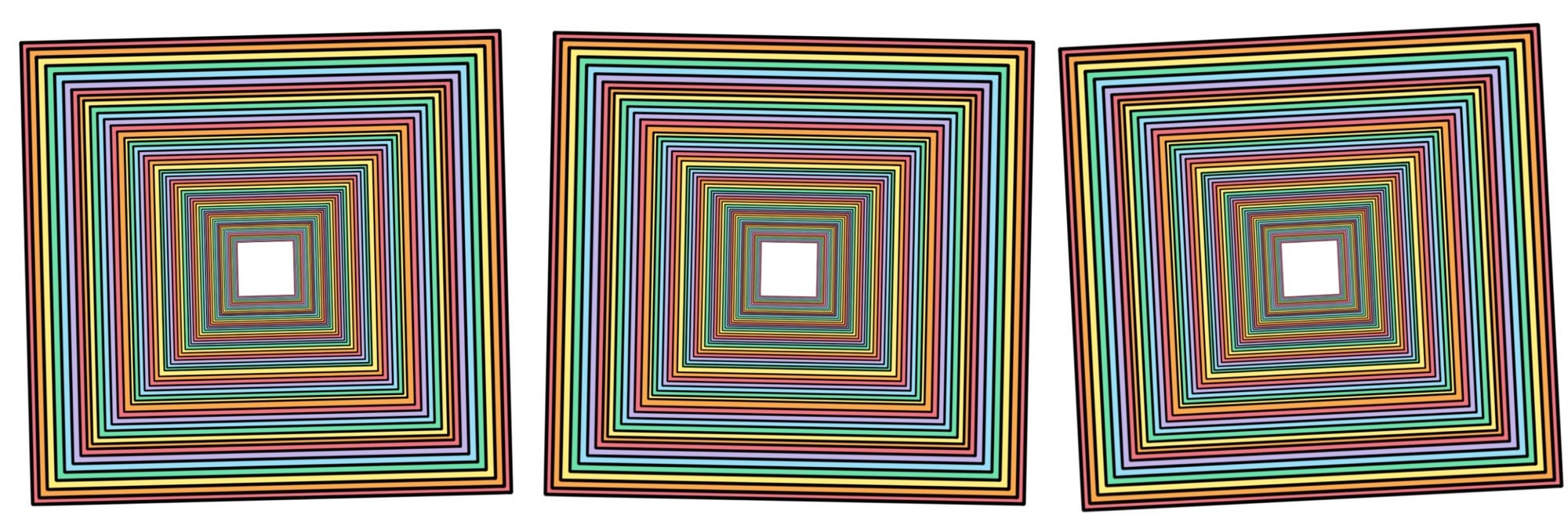
In thinking about the inward and outward movement in the poem, about nesting dolls, and about progressions of repetition, I thought about images that do that.
A long time ago, I talked about a children’s book that has no words but that I remember showing a scene within a scene within a scene. In recent years, there have been lots of these images, the realities of an infinite digital canvas allowing one to zoom further and further into the work and then, of course, zoom out.
I might have simply dubbed this as meta, but in the context of images, this is properly called the Droste effect:
The Droste effect (an example of mise en abyme) occurs when a picture appears within itself, and within that picture, the picture appears again, and so on. It is an example of visual recursion that embodies the idea of an endless progression. (I don’t think of it as a loop because you are always moving forward, deeper and deeper (and smaller and smaller) into the repetition (or in reverse), but this is often described as a loop.
The Droste effect gets its name from a 1904 Droste cocoa tin that shows a woman holding a tin with the same image on it. If we could then look at the tin in the second, smaller image, it would also feature the woman holding a tin displaying the same woman holding a tin, an infinite array of tiling images. Trippy, right? Cool.

Flotsam

I remember being intrigued by the book that I knew had some level of recursion, (although it’s not truly recursive in the Droste effect way). It took some creative searching to figure out the title, but I found it. (Thank goodness for almost twenty years of show notes.) The book is Flotsam by David Wiesner. If you read a summary, you will learn that in Flotsam, a camera washes ashore, and a boy at the beach finds it.
This book is so much more than that. I remember as a parent talking through what was happening, gathering clues from the images and piecing together the story. It’s a quick read, wordless as it is. I remember almost wishing the story was spelled out for me so that I didn’t have to piece it together in order to share it with my kids. But, really, the piecing together, the shared construction of narrative, and the willing suspension of disbelief are part of the magic.
I pulled a digital copy of Flotsam this week for a fresh, older-me, look. (The physical hold didn’t arrive in time.) I really only remembered that there was an unexpected level of recursion. I had forgotten that the camera, which washes ashore covered in seaweed and barnacles, is, specifically, a Melville underwater camera. Before finding the camera, the boy is examining a crab with a magnifying glass. There is, oddly, a microscope in a bag near his things. (All kids take a microscope to the beach, right?) I didn’t remember the boy going to the nearby one-hour photo place and processing the film and then returning to the beach to look at the pictures.
I didn’t remember the amazing and surprising pictures (revealed in the developed photos) from the underwater world, wide-ranging pictures that include a mechanical fish, an octopus family sitting in their cozy living room, fish getting a ride on pufferfish balloons, aliens, giant starfish that carry islands, and a wonderful image of sea turtles covered in cities of swirling hermit crab shells.
I didn’t remember the nature of the recursion, just that it existed.
One of the photos is of a girl, holding a photo of another child holding a photo…. The boy puts his science tools to use examining the layers and then takes a photo of his own and…
What would he do in this story?
I won’t ruin it, just in case you decide to look at this with a young person in your life.
Flotsam is a story that tugs on the magic of children, on their willingness to believe and, ultimately, to participate in something larger than themselves. The artwork is incredible. It’s a really special book, and I’m really glad that I thought about it again this week and took the time to figure out what it was and take another look.
As I made notes throughout the week, I kept thinking flotsam and jetsam, flotsam and jetsam. Finally, I looked these words up. The definitions offer an interesting layer of context. Both are types of marine debris, but one arises from chance or accident:
Flotsam: debris in the water that was not deliberately thrown overboard
Jetsam: debris in the water that was deliberately thrown overboard to, for example, lighten the load of a ship in distress.2
(Despite the title, the camera in the story isn’t clearly either!)
Lost in Time
I think I am sometimes stuck on that island in that tree in that nut in that kernel. There has been another island and another tree and another kernel and another and another and another. I am living in this perpetual state of the past.
What is different than before?
Haven’t I always been this philosophical, overthinking, melancholic, lonely, loner, invisible person? Maybe.
What is different now is the sense that time stopped.
Days have passed, and weeks, and months, but there is no forward.
Studying this poem this week also made me think of Here, by Richard McGuire, a book I truly love.
From Episode 319
“You find yourself singing a song... Then you realize the lyrics are the perfect commentary on your thoughts. Your subconscious has selected them like a jukebox." (Richard McGuire, Here)“There is that feeling to this book... this humming of a thread... a continuous line through history and family... it's seductive... it's something nagging at your consciousness... the half forgotten memory floating into view... the looking at this space through the decades.” (Amy, Episode 319)


Even my process today is one of recursion, mining old show notes, wondering or realizing how many times I have talked about the same things.
Life feels recursive. I am living in this liminal space between past and present. The future has dropped out of sight.
Tawny nets of yellow…
I’m stuck in a time warp.
I am trapped in a box.
I am standing. I am sitting.
It seems like everything ended.
All that is left is the digging and sifting and piecing,
The asking, the rehashing, the wondering,
The opening of dozens of nesting dolls,
No answers, no future
I am piecing, sifting, digging,
Sitting, standing, stuck.
I was always meta. Being in literary theory, we were always talking, self-reflexively, about the thing, talking and talking and analyzing and deconstructing the thing, or, even better, talking about the not thing, the thing that wasn’t there. (I’ll never not miss that me.)
To some extent, I’m still doing the same thing, a magnifying glass aimed at life itself, at this thing we are doing or not doing and at the walls inside this set of nesting dolls. If you cup your hands and yell, the echoes might reach me.
In the Sounds and Seas
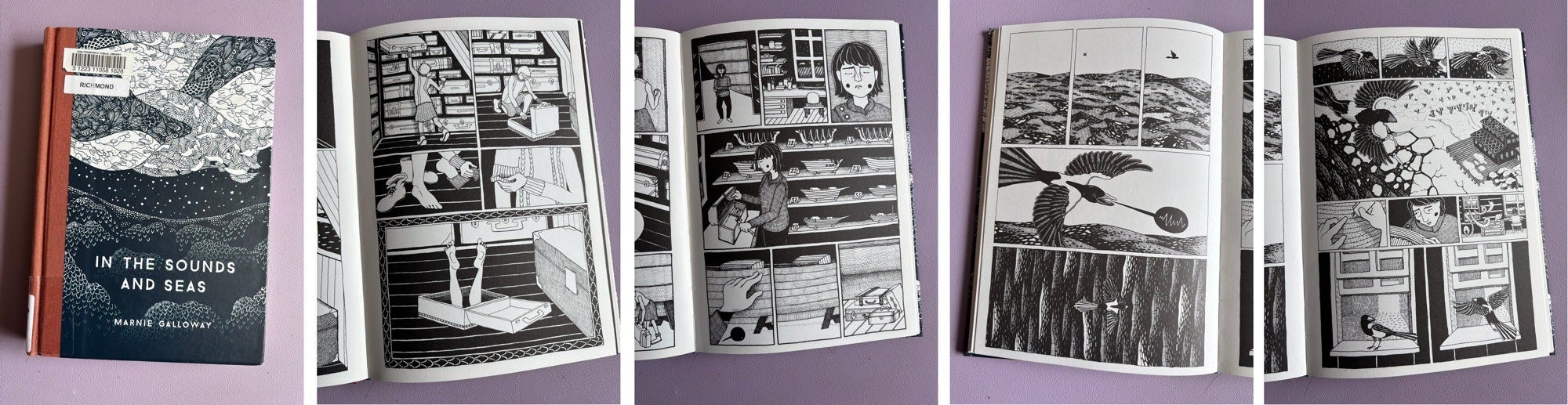
In the Sounds and Seas by Marnie Galloway fits in surprising ways with the other things that have been a part of today’s letter.
This is a graphic novel with no text. You have to follow along and construct or reconstruct the narrative based on the beautiful illustrations, pen and ink, that make up this story. There is something incredibly surreal, mysterious, and mythical in the feel of this book. There is a certain amount of whimsy in the telling. There are signs and symbols.
The illustrations are intricate and involve really strong lights and darks. There is a ton of detail and pattern, line work, hatching, tessellation, and fill-in. And, at the heart of In the Sounds and Seas, there is the story of an amazing boat that the characters build and then journey on, and, ultimately, tragically, what happens on that trip. This is really a fascinating and beautiful book.
➡️ Marnie Galloway’s Sketchy Substack
Weekly Bits and Pieces
Making Comics Read-Along Week 2 (and schedule for Week 3)
Made It?
Thank you for reading along! I always enjoy your comments and invite you to chime in. Let me know what stands out for you, what you think after reading, or where we connect.
I never had nesting dolls. You? Do you still? (If so, please send me a photo!)
What did you wake up today and say you were thankful for? (If you didn’t, think about it now… what is the first thing that comes to mind?) Is it okay if it’s the same thing every day? Yes. It is. Could you broaden your gratitude awareness if you write down three things a day? Yes. Yes you could.
I don’t view my time at Illustrated Life as a hobby. I’m not haphazard about it. I spend days and hours. I am serious about my presence here, about my writing, about Illustrate Your Week, and about the art I make and share. I am always hoping to reach more readers who might find inspiration, resonance, or homecoming in the way I talk about creativity, creative habit, and the documentation of life. You can help by clicking the heart ( ♥ ) to show you’ve enjoyed the post, restacking to share with others, highlighting any line in the post and restacking something specific (which works beautifully), or commenting below.
I’m really grateful for those of you who read, comment, and have stuck around this year.
Reminder! Reminder! If you want to make sure you do NOT receive extra emails about the Making Comics read-along, please follow the steps shown at the bottom of this post to toggle the read-along off. No one has time for extra email they don’t want!
I only routinely email once a week—the Sunday post.
Notes3
Thank you for reading Illustrated Life. Writers need readers, and I am grateful for every reader!
Paid options are available for those who find value and inspiration in the weekly posts here and want to support Illustrated Life, the podcast, and the #illustrateyourweek prompt series. Subscriptions not your thing? One-time tip jar donations or wish list treats (or gifts of ink, coffee, fodder, or inspiration from other sources) are always appreciated.
Current discount on annual subscriptions. (Must use the link.)
By the way, I draw with a small group of women for an hour on Sunday mornings via Zoom. We draw. We chat. It is casual—and free. If you are ever interested in joining, let me know. You might be surprised how easy it is to just relax and be with other people when half of your attention is focused on what you are drawing.
Disclaimer: all views are opinions. Nested squares image may be perceived as in motion. Reader should skip the image if there are any concerns.
Unless otherwise noted, all images in this post are ©️ A. Cowen. All rights reserved.
Links to books are Amazon affiliate links. Always check your library.
I am a rule follower, but the excerpt is a bit longer than the terms. I read the poem aloud in order to talk about recursion in the poem. I wanted you to hear and love the poem, and you can’t get a sense of the poem if I read only the first few lines. To make sense of today’s letter, you should read the rest of the words.
It turns out “Warning to Children” was a poem my son selected for a high school project. I didn't remember that when I first found the poem. He didn’t remember that when I asked him later. In between, curious why I had this poem, I riffled through digital files and found show notes for Episode 172, where I talked about the poetry unit he was doing. At the time, I linked his interest in the poem to the imagery that evokes Minecraft. I don’t seem to have mentioned the recursion. (It wasn’t my school assignment.) It’s just a weird throwback that I found the poem this week, and this time, it was “my” time to live with it. I’m not fifteen. I’m older, more philosophical, and more skeptical. It hit me just right.
On things washing ashore…. As I finished, I thought about A Tale for the Time Being (Ruth Ozeki), which I started and didn’t finish this year. (It’s been a frustrating year for reading.)
I’ve talked about Station Eleven many times. (It’s probably time to read it again.) There was some Station Eleven/octopus confusion this one time… (Episode 448).
I would definitely read The Starless Sea again. I could wind out my days just rereading things I know I’ve loved. I really hope I find my peace with reading in coming months. The number of books I’ve checked out in the last year is almost laughable, really, given how little I’ve followed through. I’m reading a graphic novel right now that I think really requires a magnifying glass.
* Flotsam, jetsam, and detritus are three of my favorite words, but after all this time, I didn't realize (or have forgotten) the role that intentionality plays in the definition. Although stopping for a moment to think about it (something challenging for my brain) you would know that from looking at the words.
* The word recursive came up for me twice last week. I had to look it up the first time, although again, I guessed the meaning based on the word, I just wanted to be sure. I have either never seen it in writing, or it has been so long that I have forgotten (this seems to be a theme). Strange that it would pop up as your theme this week. Unless maybe we saw it in the same place and it burrowed into your brain triggering the post....
* In the house of my early childhood, we had a half bath under the stairs. I always loved it, because the ceiling was slanted, and because there were mirrors on two of the walls and you could create your own Droste effect (all the new vocabulary today) and I spent spent hours in there doing just that.
* Sometimes I feel like I am standing still like Sisyphus, battling the same challenges day after day. I want to imagine Sisyphus happy, and in many ways I am content. I am currently experiencing high frustration with the problems that can't be solved and it is making me extra cranky. On the other hand, there are moments where I feel like time is hurtling forward, and I am not ready to face the things I feel like I should have been preparing for all this time.
* I woke up thankful for Augie, who was there hogging my blankets, sleeping peacefully after keeping me up all night. I was thankful that my neighbors were all expecting me to come out and walk (even though I really wanted to sleep).
* I did have nesting dolls, brought back by my grandparents from a trip, I think. My mom's parents owned a travel agency back in the day and went all over the place. I don't have them anymore, but it is something I can imagine myself buying. I have always been interested in mysteries inside, miniature rooms in walnuts, images of cross sections of houses and castles, bunnies cavorting in sugar eggs.
1. I didn’t have nesting dolls, but my mother did, and I do remember playing with them and being fascinated by them. I don’t have them; I think one of my brothers does.
2. I think I’m in an endless loop, especially during those times when I think I’m moving forward and something pops up to remind me I have unfinished business.
3. Didn’t wake up with gratitude, but the first thing that comes to mind is my home, rustic and needing repairs as it is. I am very grateful for it. And the other two? Those I share it with: 2. My spouse, and 3. Our cats.
Other thoughts (what a goldmine you are, Amy! I actually keep a running note every week when reading your Sunday letter because it sparks SO much in me!
A. Your pulling out of files makes me realize I need to use my bookcase to house all my 70+ journals and maybe get a different thing to keep my art supplies in.
B. The Droste Effect reminds me of fractals and the Mandelbrot Set.
C. Will definitely check out the wordless novels. Made me remember a book I loved from 2007, The Invention of Hugo Cabret, by Brian Selznick. Hugo is an orphan, clock keeper and thief who lives in the walls of a Paris train station. It’s a marvelous book.