

Telling Half-Stories
Small stories, fragments, stories about stories, a failure of imagination, and doubt, lots of doubt

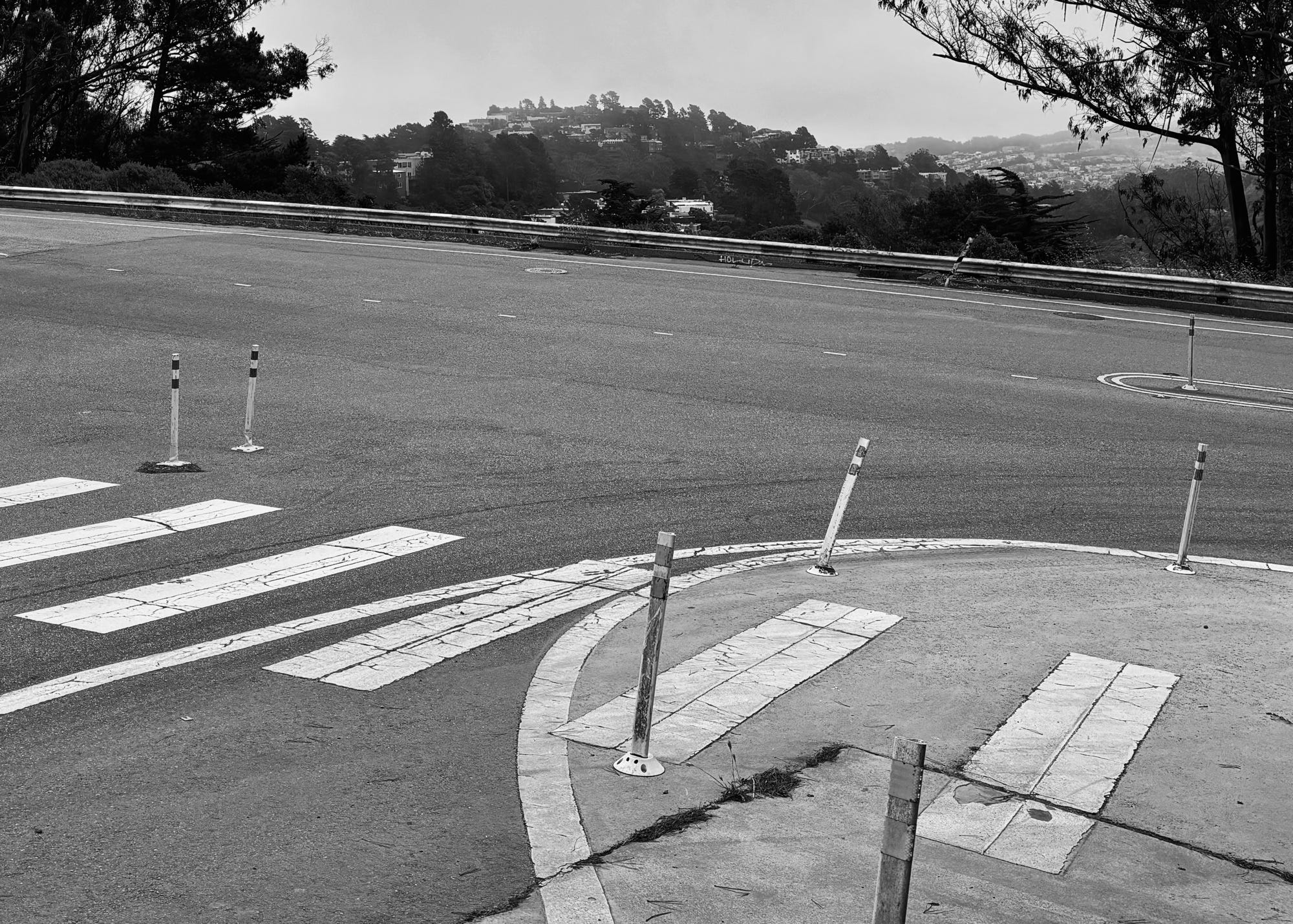
This week: Half-Stories ⭐ Illustrated Journal ⭐ Looking Back ⭐ Fun Finds (Goblins) ⭐ Illustrate Your Week Prompts
“Fiction is like a spider’s web, attached ever so lightly perhaps, but still attached to life at all four corners.”—Virginia Woolf
“The function of imagination is… to make settled things strange.” —G. K. Chesterton
🎯 Thank you to those who support this space
with monthly or annual subscriptions, donations, or gifts of dice, paint, ink,
and scraps for making nests, filling snow globes, and keeping lanterns lit.
I hope you are inspired to make time each day for your creative habits, to value the documentation of your journey, and to explore your relationship with memory.
Thank you to those who read, comment, ❤️, and share.
📌 A Half-Story
I have not been in this library in more than thirty years. I carry only the impression of a long rectangular building on a hill and the echo of the word ‘stacks’ as an anchor in memory. Nothing else. I arrived here today and found that my card still opened the door. All of the shelves were empty, and yet patrons were sitting at small tables by windows, surrounded by piles of open books.
Finding a free table on the second floor, I sat and pondered the empty shelves stretching in every direction. I had come looking for something undefined, something felt more than articulated, something I didn't know how to find. I couldn't have explained the certainty that ‘muses’ are important, a hinge in a system that has become difficult to maneuver. I planned to wander, scan spines as if reading a pile of cast bones, and see what books might surface. I planned to watch for foxes and wolves and signs of synchronicity.
As I sat, a woman at a nearby table closed a book and added it to a pile with two others. Grabbing a slip of paper, she wrote quickly, pausing only once to glance out the window before she continued. When finished, she tucked the slip inside the book and returned to her notes. The pile vanished, and a minute later, another book appeared. Picking it up, she seemed surprised and yet pleased as she studied the cover and then opened the small volume.
Dropping my eyes from the deep green of the book’s cover and her long silver hair, I looked at the table at which I sat. In the center, pushed to the edge against the wall, almost invisible in the bit of shadow, were a few slips of paper, a single half pencil, and a small placard that read:
No-Wander Search—6AM-Noon
List title, author, keyword, or emotional tenor.
Taking a slip of the paper, I started to write what I sought when a rustle blew through the room, the sound of thousands of dominos standing back up in sequence. The shelves were once again full of books as the clock struck twelve.
📌 Half-Stories
Evolve. Revolve. Devolve.
This week held contemplation of half-stories, a prismatic look from multiple angles, each refracting in different ways and from different starting points but bending back again toward the same center, and an unexpected study of regress and recursion.
1.
Imagine a Plinko machine, the kind next to the cakewalk.
If I start the ball here... where will it bounce to? Will it lead to a lollipop? A sonnet? A philosophical treatise disguised as a fairy tale? A haiku written in reverse? A reminder of darkness?
Pausing to contemplate the metaphor, I realize it will not do. There are not enough options. I don’t want a grid of a hundred or so. I want a grid of thousands of small pegs to interrupt and divert the path. I want to map variance and multiplicity, echoes and divergence. What if I start there? What if I drop two balls at once? What if there are embedded mirrors, pegs that are angled or bent, and paths that refuse to follow the rules of physics?
I enjoy the randomness of the path, the way words string, ideas connect, and constellations appear. If lines are drawn between the dots, the image will always be abstract, a moment that draws you back into the looping nature of the labyrinth.
But this is a half-story. It may be that this labyrinth has no center, no path that resolves to an exit, and no path back. There may be no final numbered dot. They may continue to appear, just as you think you’ve found the last one.
The ordinary Plinko machine does have an end. The ball will come to a rest at the bottom after an indeterminate number of bounces along an undetermined path. The fact that the ball might land in any slot and still make sense, still invite both horizontal allusions and vertical stacking with other balls, both semantic play and visual coherence, is exciting.
The ball can be dropped an infinite number of times.
Standing at the machine, day after day, and recording the starting point and where the ball lands is both observation and documentation. This is phenomenology. The path may be random, but the process of repeating the experiment and tracking variables and outcomes is a system. Patterns can be detected. Probabilities can be calculated.
But what if some paths are quietly inaccessible, and I don’t know until later? Is the path the ball took still valid? Or was it supposed to be different?
Am I winning a toy duck, a small wolf carving, or a tiny gnome at the bottom? Or am I describing a process by which something unknown unfolds from an origin point, and the path of the ricochet is the narrative thread?
2.
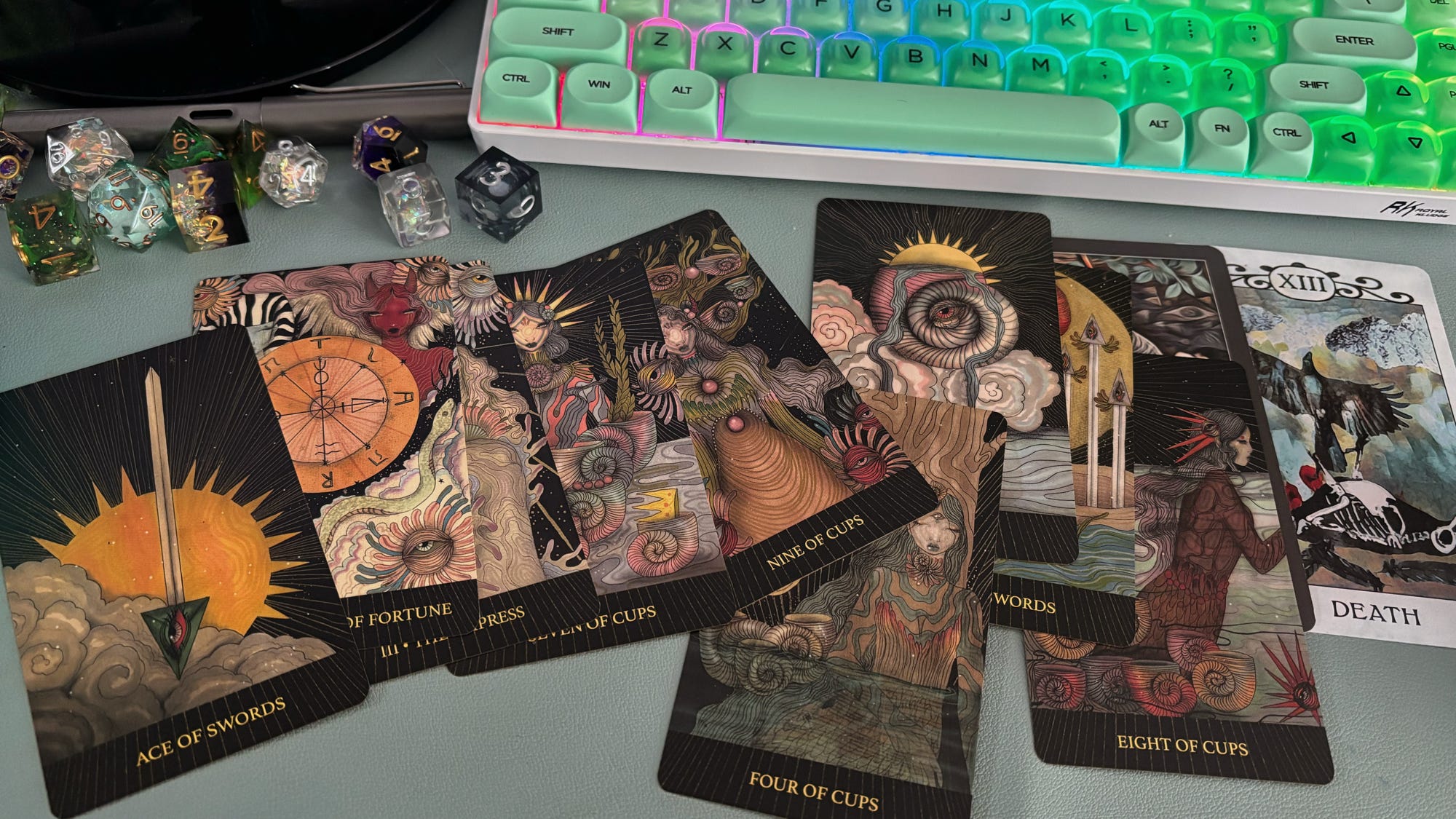
I keep finding tarot cards that I’ve left out to photograph or draw.
Sometimes after a reading, I’ll find a card stuck between the cushion and the chair, still in the bottom of the box, or mixed in with other cards. The elision is unintentional, but the pulls are sometimes from incomplete decks, and I am left to wonder if the story would have been the same regardless or if I skewed the narrative. If all the cards had been in the deck, would I have pulled something very different? I wonder, too, about the cards that seem to fly out of the deck. Sometimes I take them, and sometimes I just shuffle them back in.
Every pull is random, a shot in the dark, although the percentages are easy to figure. I’m not wholly convinced that the story isn’t roughly the same each time no matter what cards arrive. But finding cards that have been accidentally left out always makes me wonder.
3.
I gave myself a small task this week while walking around the block before heading into the library. It started as an exercise in noticing, with a scavenger list I didn’t use. What emerged was a particular aperture for seeing.
…a giant stone cat on a porch, noticed only as a corner is rounded.
…a tree with a narrow vertical gap where it seemed the trunk has split and fused again, leaving a sliver of an opening you can see into.
…another tree with a gap, but the splitting of the trunk happened low to the ground, after which there are a number of thick rising branches and a deep vertical hole in the middle that you can see through, like a window.
…light lilac-blue flowers on a building-high shrub, flowers you can only see from a certain angle, flowers I spotted weeks ago and didn’t find again for many days.
…a stone rabbit in a large pot of weeds.
…a statue of a frog on a fountain that only appears in the moment you pass it and always looks like a headless figure before it resolves into a frog.
…a tree full of yellow roses, two light purple ones tucked in, idiosyncratic.
…a large green tree full of green limes, indistinguishable in color from the leaves, only visible when you take in the lines.
4.
The title of a file one night this week has a key searchable word, doubt. I tucked more specific and telling labels inside as I grappled with unexpected freefall. I was aware when the cliff gave way. I had been tentatively building a bridge, one made of glass, one that sways, one that can change size and shape and perspective, one that can be a ladder as easily as a walkway.
Glass recurs as an unexpected material and metaphor. A greenhouse with a multi-colored roof has become a touchstone, but there have been many alcoves where glass containers, orbs, windows, mirrors, and lenses hold, carry, and invite meaning. Somewhere along the way, I began not only weaving thread but casting glass, inverting a process and rejecting a story I’ve always told myself about my writing. I’ve been crossing bridges, wandering ruins, and walking in a forest that unfolds only as I move forward with each step.
This week I’ve been caught in a tailspin of doubt with roots in visualization, imagination, memory, and the differences between a well and a shallow pool, between surface-level semantics and something more expansive. I’ve stood at the edge studying voids, the fear of the chasm, and the worry that there is only the thinnest surface reflection and that I am unable, really, to follow deeper.
Maybe I was right all along.
My whispered fear destabilized the ground.
The clear thought that I am always telling half-stories added to the swirling vortex, and I continued to descend. The ground continued to crumble. The dangling bridge shattered. The doors disappeared.
What does it mean if there are only half-stories? What does it mean when something hybrid emerges, a new path, and then the ground crumbles, thins, or shrinks? What does it mean when failure of imagination and memory control the board and the shifting terrain? What does it mean when they fuse?
What does it mean to stand to the side and talk about the half-story, tell the quarter-story, or the eighth, the sliver of detail that hints at a story that itself is only a fragment of a story?
What happens if stories are always just a small peek into the View-Master, the snow globe, the faded photo, always just a blurred image that will never resolve? What if all half-stories are really the same stories, hovering in the same field, walking the same circle?
I keep reminding myself that echoes are not replicas, and half-stories may be partial or incomplete, but they are not the same as half-truths.
I am still caught with a metaphor of a shallow pool.
This, too, is a half-story.
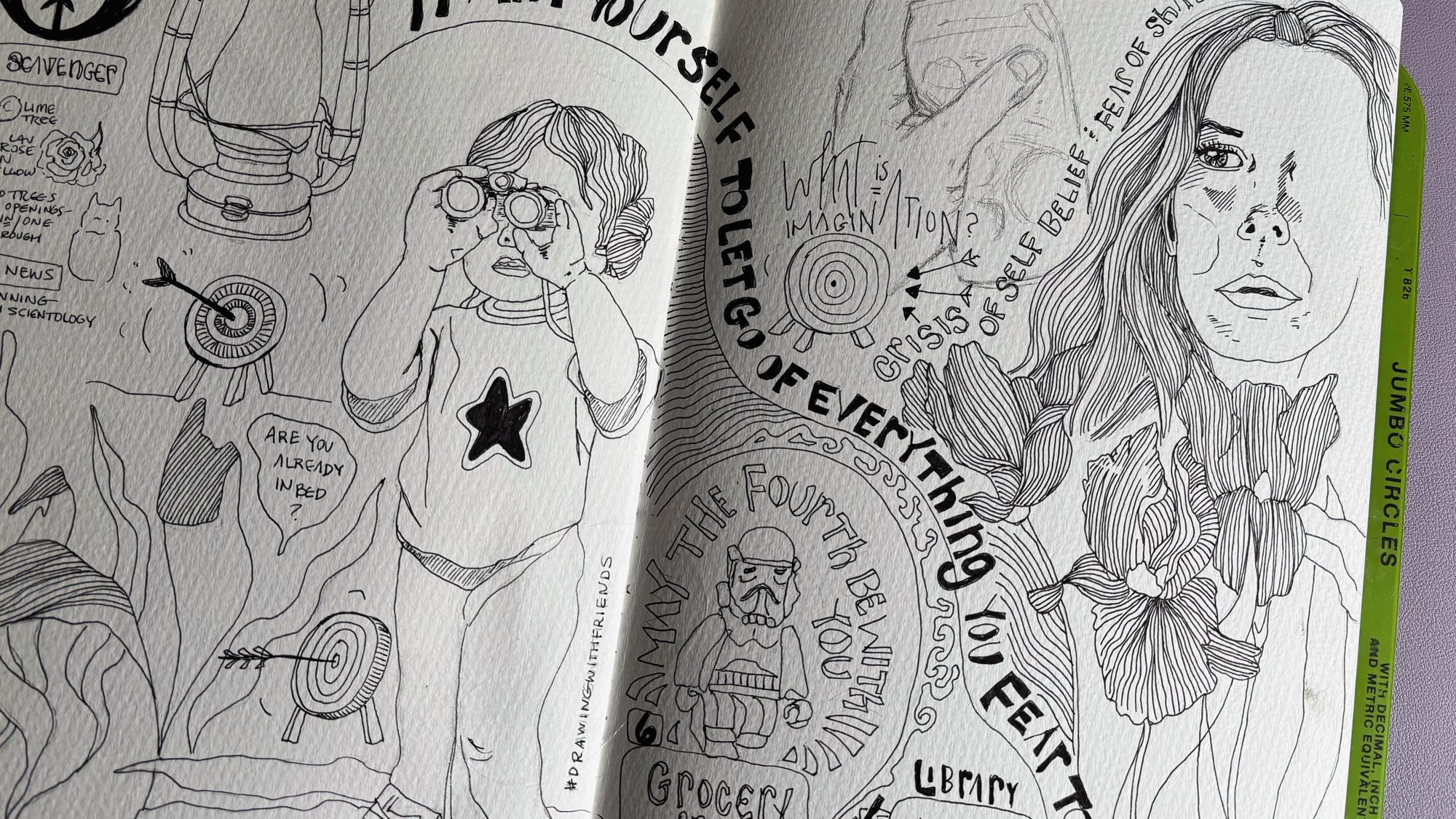
Illustrated Journal
Looking Back (Year Over Year)
There were a number of odd stumbles into past files as I worked on today’s post. Things cycle in ways that are disconcerting and in ways that hint both at what is going on and at what it means to be a writer over decades. There are echoes, and sometimes they are uncanny, ironic, haunting, and ghostly as they drift into view with timestamps and dates that show not only that things recur but that there may also be a period to the orbit.


2025: Pink Shirts in the Garden; an Apple and a Pear (this poem)
2025: Tawny Yellow Nets (this poem; recursion, but early)
2023: The quiet power of limiting
2023: Review of Look Again by Elizabeth Trembley (graphic novel)
Fun Finds
Goblins: This reel at Instagram is a total delight. (For those doing Illustrate Your Week, this is the “why” of the goblin prompt.)
Diary Comics: My interest in graphic novels and personal (or diary) comics is part of what led me to find my own way with illustrated journaling many years ago. If only I could visualize and draw from my head more easily. If you, too, are interested in this comic form, check this great post from K. Woodman-Maynard: What Diary Comics Are (and Why I Love Them).
(I do use reference photos, but my lack of visualization is a huge roadblock. It makes me endlessly sad that I can’t just draw from my head.)
For anyone wanting a self-paced refresh or a toe-in-the-water with comics, our read-along notes from Lynda Barry’s Making Comics are here.
Illustrated Journal Prompts
Made It?
Thank you for reading.
I always invite you to enter the conversation in any way you wish.
This week, you might start here:
Name something you noticed recently that surprised you
What color comes to mind in this moment
Two rhyming words
Thank you for reading Illustrated Life. Writers need readers, and I am grateful for every reader!
Paid options are available for those who find value and inspiration in the weekly posts here and want to support Illustrated Life and the #illustrateyourweek prompt series. Subscriptions not your thing? One-time tip jar donations are always appreciated.
Unless otherwise noted, all images in this post are © A. Cowen. All rights reserved.
Links to books and products at Amazon.com are affiliate links. Always use your library when possible.
I liked how this post talks about telling half stories and how perspective shapes understanding. It was thoughtful and engaging. https://www.dannasouthwellauthor.com/
I was surprised to see a roadrunner nearly zoom off a four-foot retaining wall, yet catch himself and run right back (into the hedges) the way he came. It was so comical; it really looked like a ‘loony toons’ moment. I couldn’t help but grin and was so glad I had been looking up instead of into my phone. I love your library (half) story Amy, it is a space I would love to imagine more about. Thank you for sharing and have a great week!